Why Are Ticketing Systems So Expensive?

Price out a helpdesk for a two-person team and the numbers feel strange. A shared inbox, a knowledge base, some automation — conceptually a CRUD app with an email pipe — routinely costs more per month than your database, your hosting, and your error tracking combined. Why?
The short answer: you are not the customer these products are priced for. The pricing model of mainstream ticketing systems is an artifact of who they sell to and how they sell, and once you see the mechanics, the sticker shock makes sense — and so does the way out.
The going rates
Prices move around, so treat these as approximate 2026 figures for the mid-market tiers most teams actually end up on:
| Product | Per-seat price (approx.) | AI add-on (approx.) |
|---|---|---|
| Intercom | $29–132/seat/mo | $0.99 per AI resolution |
| Help Scout | $25–75/seat/mo | $0.75 per AI resolution |
| Zendesk | $19–115/seat/mo | Per-resolution pricing on AI agents |
| Freshdesk | $15–79/seat/mo | Usage-priced AI (Freddy) add-ons |
| Front | $19–99/seat/mo | Usage-priced AI add-ons |
Run the arithmetic for a small team. Two founders on Intercom's mid tier at roughly $74/seat is about $148/month before AI. Add a part-time contractor who needs to see the queue two days a week: another full seat, because seats don't prorate. If the AI agent resolves 200 conversations in a month at $0.99 each, that is another $198. A two-and-a-half-person support operation can clear $400/month — for software whose marginal cost of serving you rounds to zero.
The economics behind the seat
None of this is a conspiracy. Per-seat pricing exists because of three structural facts about how these companies operate.
Sales-led companies price for the buyer, not the user. Enterprise helpdesk deals are closed by sales teams talking to VPs of Customer Experience. A VP with a 40-agent org has a headcount budget, and "per seat" maps perfectly onto it — the software bill scales with the same line item the VP already manages. Seats make deals legible to procurement. That the model is hostile to a two-person team is not a bug the vendor needs to fix, because the two-person team was never in the sales pipeline.
CAC has to be recovered. When a customer costs thousands of dollars in sales and marketing to acquire, the vendor needs a mechanism for revenue to grow after the deal closes. Seats are that mechanism: your team grows, their revenue grows, no renegotiation needed. Expansion revenue is what makes the CAC math work, and it is priced into every tier — including the ones self-serve customers land on.
The meter follows the value story, not the cost. Per-resolution AI pricing is pitched as alignment: "you only pay when the AI actually resolves something." But notice what is being metered. The vendor's cost is inference — fractions of a cent of compute. The price is $0.75–0.99, anchored not to cost but to the claimed value of a deflected human interaction. That is value-based pricing, and it has a property vendors love and customers should notice: your bill scales with your success. More users, more questions, more resolutions, bigger bill — with no ceiling you control and no economies of scale passed back to you.
There is also a quieter incentive problem. A vendor paid per AI resolution earns more when more conversations flow through the AI. A great knowledge base that lets users self-serve before opening a conversation is, in the strictest revenue sense, bad for that vendor. You would like your tooling's incentives pointed at fewer support contacts, not more billable ones.
Why this punishes small teams specifically
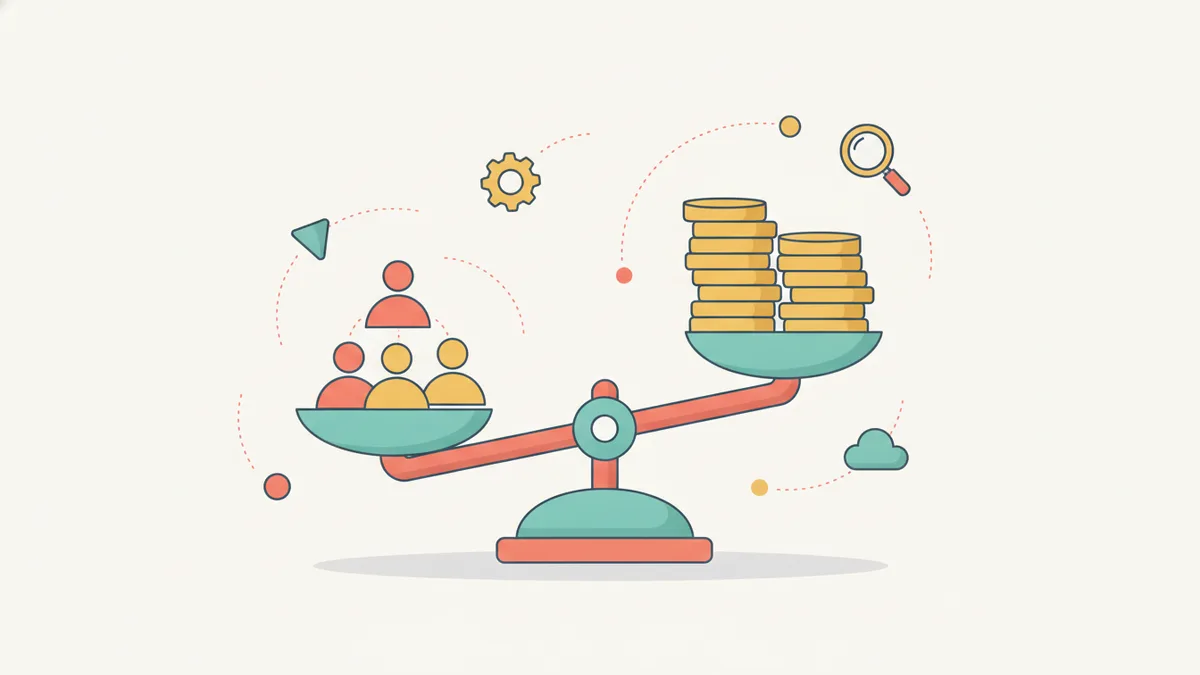
Per-seat pricing embeds an assumption: that the number of humans logged in tracks the value delivered. For a 40-agent support org, roughly true. For a small software team, false in both directions.
A solo developer with three products gets less than one seat's worth of human capacity — but needs the full surface area: helpdesk, docs, email, automation. They pay for a seat model that measures the one thing they don't scale (headcount) and ignores the things they do (products, volume).
Meanwhile the collaboration penalty runs the other way. The moment you want a co-founder to see the queue, the price doubles. Want to give a freelancer read access for a launch week? Another seat. Seat pricing taxes exactly the behavior — sharing context — that makes support better. Small teams respond rationally: they share logins (against the ToS, and it wrecks assignment and audit trails) or they keep support siloed in one person's head. Both outcomes make the product worse at its job.
The AI meter compounds it. A small team is precisely the team that most needs deflection — there is no one to absorb volume spikes — but per-resolution pricing means the month your product gets featured somewhere is the month your support bill spikes alongside your server bill. Unbounded, success-linked costs are manageable for enterprises with procurement buffers. For a bootstrapped product doing a few thousand in MRR, they are a reason to leave the AI off.
What a fairer model looks like
Developer-tools companies solved this pricing problem years ago. Sentry does not charge per engineer who can view an error; Postmark does not charge per teammate who can see the email log. The pattern is consistent:
- A flat platform fee that covers the product and the whole team. Collaboration is free because collaboration costs the vendor nothing and makes the product stickier.
- Usage-based metering on real marginal costs — events, emails sent, storage — with generous included quotas and predictable overage. The meter tracks what actually costs money to serve, so it grows slowly and transparently.
- No penalty for adding humans. Inviting a teammate is a settings page, not a purchase order.
Under this model, the two-person team from earlier pays one flat fee whether one person or four can see the queue, and their AI usage is either included or metered at something resembling cost. Their bill is boring and forecastable, which is the highest compliment a small team can pay an invoice.
This is the model we chose for Helmdesk — flat plans, unlimited teammates, AI included without a per-resolution meter — not out of generosity but because the developer-tools pricing playbook is simply the honest fit for how small software teams work.
The takeaway
Ticketing systems are expensive because their pricing was designed in rooms where the customer had 40 agents and a procurement department. Per-seat fees recover enterprise acquisition costs; per-resolution meters convert your growth into their expansion revenue. Neither has much to do with what it costs to serve you.
If you are a small team, the fix is not negotiating a discount on a model built against you. It is choosing tools priced like the rest of your stack: flat where the marginal cost is flat, metered where the meter measures something real, and free where the "feature" is just another human being allowed to help.
A helpdesk priced like a developer tool
Flat plans, unlimited teammates, AI included — no per-seat fees and no per-resolution meter. Your bill stays boring while your product grows.