Feedback Conversations Are Not Support Tickets
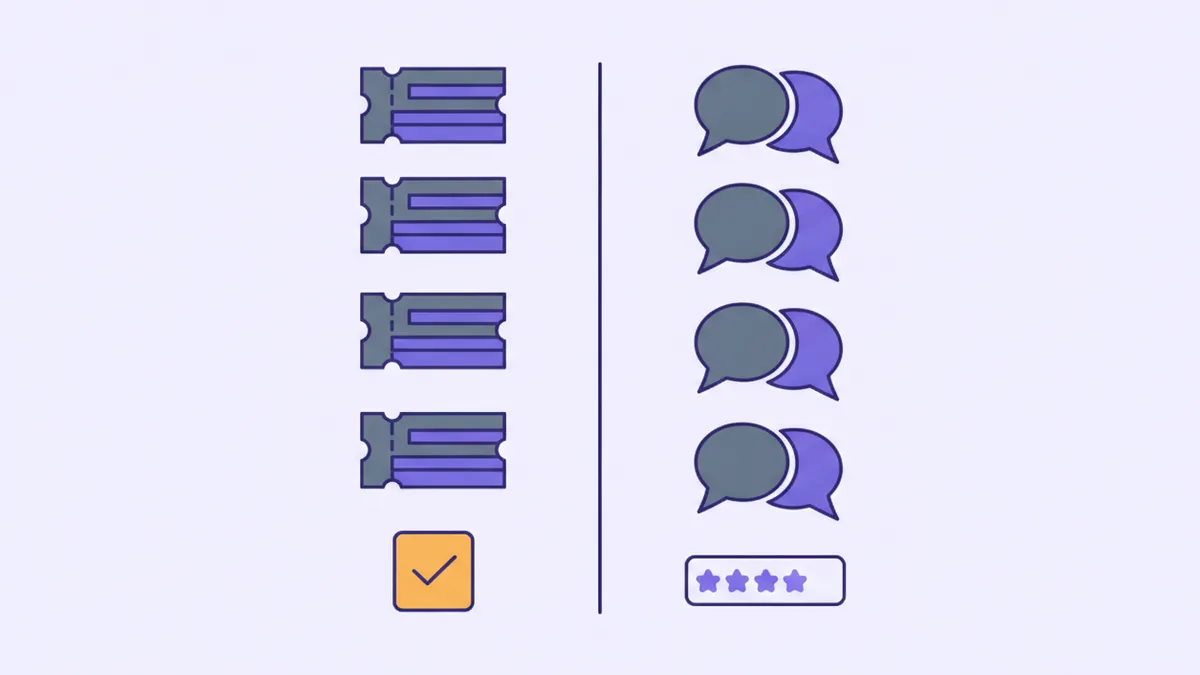
Two messages land within a minute of each other. The first says the CSV export produces an empty file when the date range spans a month boundary. The second says the new dashboard is "fine, I guess, but I liked the old one better and now it takes three clicks to get to my invoices."
Both are text from a customer. Most support tools will put them in the same list, give them the same status field, start the same timer on both, and let you mark both resolved — and that is where the damage starts.
The pitch for one queue is appealing, and every unified inbox makes it: fewer places to look, nothing falls through, one number to watch. It is a good argument about storage and a bad argument about work. Those two messages want different things from you, on different clocks, with different definitions of done — merging them does not simplify your day, it hides the fact that you have two jobs.
This post argues the split by what each queue is for, what happens to your numbers when you conflate them, and how to tell whether an ask for feedback ever landed — then concedes where the split is premature, because at genuinely small scale it is.
A problem with a resolution, an opinion without one
A support ticket is a problem with a resolution. Somebody cannot do a thing they are entitled to do. There is a state where that is no longer true, you can get to it, and when you do, the ticket is finished. That is why tickets have a status ladder — new, open, pending, resolved — and why each rung is a claim about where the problem stands.
A feedback conversation is an opinion. It has no resolution because nothing is broken. "I liked the old one better" is not a defect — it is information about a person. You can reply to it, act on it, disagree with it, and none of those close it the way fixing the export closes the export bug. The most you can honestly say is I have read this and I am done handling it.
Which is why closing feedback should mean something far weaker than resolving a ticket. In Helmdesk, closing a conversation notifies nobody — it is a filing action. Resolving a ticket emails the customer a satisfaction survey, because you are asserting something: we answered you. Two verbs that look identical in a shared queue and are not the same promise.
| Support ticket | Feedback conversation | |
|---|---|---|
| What it is | A problem | An opinion |
| What 'done' means | Fixed or answered | Read and acknowledged |
| The queue is | A work list to empty | A sample to read |
| A backlog means | You are behind | Nothing in particular |
| Response time | The core metric | Mostly irrelevant |
| Closing it | Sends a satisfaction survey | Notifies nobody |
| A rating measures | How you handled it | How they feel about the product |
What the queue is for decides everything
Here is the sharper version, and the one worth keeping.
A ticket queue is a work list. Its natural state is empty. Every item in it is a person waiting, so depth is a real signal — twelve open tickets on a Tuesday says something specific about your week. You triage it, you burn it down, and you feel the pressure of it, correctly.
A feedback queue is a sample. Its natural state is not empty, and depth signals almost nothing. Forty pieces of feedback is not a backlog — it is forty data points, and what you do with a sample is read it, not clear it. You read it looking for the same complaint three times, or for the thing nobody says any more because you fixed it.
Put a sample inside a work list and you get the worst of both. The pressure to empty the queue teaches you to close feedback fast — reply "thanks for the suggestion," hit close, count it — which is exactly what destroys its value, because the value was never in the handling. It was in the reading, and you replaced reading with processing.
The reverse contamination is quieter and worse. Fifteen opinions sitting alongside three genuine problems make the problems look less urgent, and queue depth stops correlating with anyone waiting. Once depth means nothing, you stop trusting the number — which is the moment the queue becomes a folder.
The numbers stop meaning anything
If the argument from purpose does not move you, the one from metrics should, because it is mechanical.
- Response time becomes an average of two unrelated things. Four hours on a broken export is a bad day. Four hours on "I liked the old one better" is unremarkable, and four days is fine. Average them and you get a number too high to celebrate and too low to act on — one that moves when feedback volume changes, which has nothing to do with support.
- "Resolved" starts meaning two things. In one row it means a customer's problem is over; in another, somebody read a comment. Nothing distinguishes them afterwards, so any count of resolutions adds two different events together.
- Ratings get crossed. A ticket rating answers "how did we handle your problem." A feedback rating answers "how do you feel about this product." Both are 1 to 5, and they can move in opposite directions in the same week.
- The backlog alarm fires on the wrong thing. Anything built on queue depth now goes off when people are chatty rather than when people are stuck.
You can patch every one of these with a tag and a saved filter, and plenty of teams do. It works until somebody forgets the tag — or builds a report off the raw table — and the number goes quietly wrong in a direction nobody notices.
Did the ask actually land?
The separation buys one measure a shared queue cannot give you: an honest funnel on your own asks.
When you request feedback — a nudge to someone who signed up and never finished setup, say — the request is a tracked object with four states. created for a link you send yourself, sent once the email goes out, opened when they click through to the respond page, responded when they answer and a conversation appears. The gaps between those states each say something different.
Sent but never opened is a delivery or subject-line problem. Opened but never responded is an asking problem — the prompt was vague, or long, or obviously a form. Responded is the only state that counts, and its ratio to sent is the honest read on whether your feedback programme works at all.
None of that survives a shared queue, because a ticket has no funnel — nobody asked the customer to file it. The funnel exists precisely because feedback is something you go out and get, and things you go out and get can be measured for whether they worked.
Where the split is premature
Now the concession, and it is real: below a certain volume this whole argument is theory.
If you get four support messages a week and hear from customers a handful of times a month, one inbox is correct. You are the triage system — you hold every open thread in your head, you have no first-response-time chart, and nobody is building reports off your data. Splitting the queue at that scale buys a second place to check and a second thing to forget, in exchange for a cleanliness you cannot yet perceive.
The split earns its keep when you stop reading every item personally — when somebody else answers tickets, when a number goes in front of an investor, or when you first catch yourself closing a piece of feedback to get the count down. That last one is the real trigger. The day you feel queue pressure applied to an opinion, the queue is wrong.
So: fix the export, and read the complaint about the three clicks. Just do not put a timer on the second one, and do not congratulate yourself for clearing it.
Two queues, on purpose
Helmdesk keeps rated feedback conversations separate from your support tickets — with a request funnel that shows whether the ask ever landed.