The 2 AM Payment Failure: Why Solo Developers Need Watchdogs

At 2:07 AM, while you are asleep, your payment provider rotates a signing certificate. Your webhook handler — the one that marks subscriptions as paid — starts rejecting every event with a signature verification error. Your app does exactly what you told it to do: it logs the error and returns a 400.
Nothing crashes. The site is up. The status page, if you had one, would be green.
At 6:30 AM, the first renewal of the day fails to register. The customer's card was charged, but your database still says their subscription lapsed. Your paywall does its job flawlessly and locks them out. They shrug, assume a glitch, and plan to try again later.
By noon there are eleven of these. Some try to pay a second time. A couple email support — the support inbox you check "when you get a chance." One posts in a community Slack that your product "seems broken."
At 4:12 PM — roughly fourteen hours after the first error — you open your inbox and find a message with the subject line "I PAID TWICE AND I'M STILL LOCKED OUT???" You check the logs. There they are: several hundred identical signature errors, stacked neatly in a file nobody was reading, patiently documenting the whole thing since 2:07 AM.
The fix takes nine minutes. The cleanup — refunds, apology emails, manually reconciling subscription states, winning back the person who posted in Slack — takes the rest of the week.
Why this failure mode is so common
Nothing in that story involves bad engineering. The webhook handler validated signatures, which is correct. It logged the failure, which is correct. It returned an error status, which is correct. Every component behaved properly, and the system still failed its users for fourteen hours.
That is the defining trait of silent failure: it lives in the gap between "the code handled the error" and "a human found out." For a team with an on-call rotation, that gap is covered by a pager. For a solo developer, the gap is covered by nothing. You are the on-call rotation, and you were asleep — and even awake, you were writing features, not tailing production logs.
Logs alone do not close the gap. Logs are a record, not a signal. They answer questions you already know to ask. What you needed at 2:07 AM was not a better log line — it was something watching the logs on your behalf, noticing that a brand-new kind of error had appeared, and telling you about it once.
That something is a watchdog. Here is what a good one is made of.
Anatomy of a watchdog
Error fingerprinting
The first job is grouping. Those several hundred signature errors were not several hundred problems — they were one problem, occurring repeatedly. A watchdog should normalize each error into a fingerprint: strip out the parts that vary (IDs, email addresses, timestamps, request identifiers) and hash what remains — the level, the scope, the shape of the message.
Now "Signature verification failed for event evt_8f3a…" and "Signature verification failed for event evt_91bc…" collapse into a single issue with a counter, a first-seen time, and a last-seen time. Instead of a scrolling wall of text, you get one line: this specific thing has happened 412 times since 2:07 AM. That line is readable at a glance. The wall of text is not.
New versus recurring
The second job is knowing what deserves attention. Two signals matter far more than raw volume:
- A fingerprint you have never seen before. New errors are the highest-signal event in any log stream. Something changed — a deploy, a dependency, an external provider — and your system is now doing something it has never done. That is worth waking up for, or at least worth an email at the top of the inbox.
- A known fingerprint suddenly recurring fast. An error you have seen before, dormant for weeks, now firing dozens of times in a ten-minute window. Something that used to be rare became common. Also worth attention.
Everything else — the background hum of known, low-frequency warnings — is exactly that: background. A watchdog that treats every log line as an emergency is just a louder version of the log file.
Alert fatigue discipline
Which brings up the failure mode of monitoring itself. The graveyard of abandoned monitoring setups is full of tools that alerted too much. After the third false alarm, you mute the channel. After the fifth, you stop trusting it. A muted watchdog is worse than no watchdog, because you believe you are covered.
The discipline that keeps alerts trustworthy is boring and specific:
- Cooldowns per issue. Once you have been told about a fingerprint, do not tell you again for a meaningful window — say, 24 hours — unless you resolve it and it comes back. One problem, one notification.
- Thresholds for recurrence. A known error firing twice is noise. The alert should require a real burst — N occurrences inside a defined window — before it speaks up.
- Severity floors. Alert on errors and fatals. Warnings and info lines belong in the dashboard for when you go looking, not in your inbox.
- A cap per run. If twenty issues trip at once, something systemic is wrong and one summary is more useful than twenty pings.
The goal is a simple contract: if this thing notifies me, it is real, and it is the first I am hearing of it. Every rule above exists to protect that contract.
This is also a reasonable thing to build yourself — a fingerprinting function, an issues table, a cron job, an email. If you would rather not maintain that plumbing, it is the exact shape of the Logs feature in Helmdesk: apps ship log events to an API, errors get fingerprinted and rolled up into issues, and a Log Watch agent alerts once on new or fast-recurring errors, with the cooldowns and thresholds already tuned. Either way, the architecture is the point: fingerprint, group, alert on change, stay quiet otherwise.
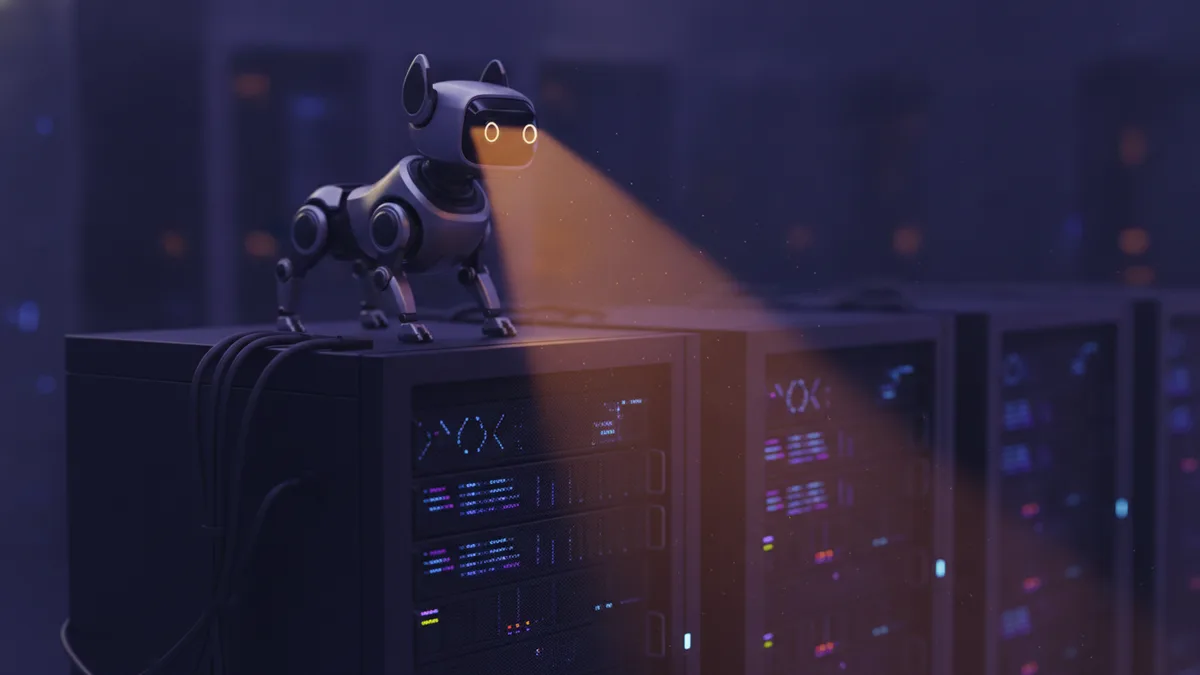
The one-person on-call rotation
There is an emotional dimension to this that does not fit in an architecture diagram.
When you run a product alone, part of your brain never fully clocks out. It is the part that wonders, during dinner or at the gym or at 2 AM, whether everything is still working. Without any monitoring, that part has only two options: go check manually — again — or carry low-grade background worry. Most solo developers alternate between both, and neither is free. The checking eats focus; the worrying eats sleep.
A watchdog you trust changes the deal. It does not promise that nothing will break — things will always break. It promises something more valuable: you will know within minutes, not hours, and you will hear about it once, clearly. The 2 AM failure still happens. But you find out over coffee at 7 AM with one email describing one issue, not at 4 PM via an angry customer describing fourteen hours of damage.
The difference between those two mornings is not the bug. The bug was identical. The difference is who told you — your own system, calmly, or your customer, furiously.
Silence from your infrastructure should mean things are fine. Until you have a watchdog, it only means nobody is listening.
Know at 2:07 AM, not 4 PM
Ship your app's logs to Helmdesk and let Log Watch alert you — once — when a new error shows up or an old one comes back.